Dating • Guide
How to Meet People Without Dating Apps
Here's the honest answer up front: meeting people offline takes more effort than opening an app — and it tends to work better. You trade twenty minutes of swiping for showing up somewhere on a schedule, and in return you skip the two things the apps are worst at: getting ghosted, and the long dead space between a match and an actual meeting. This is a guide for the person who has already decided to quit, not a sermon against apps.
TL;DR — Key takeaways
- The winning move is repeat exposure, not a single perfect night. Join something with the same faces week after week — a hobby group, a run club, a class, a volunteer shift — and go back on a schedule.
- Ranked by return-for-effort, the best venues are recurring interest groups, run/fitness communities, classes, and volunteering — each hands you a built-in reason to talk. 'Third places' (cafes, bars) work but demand the most skill.
- Apps atrophy three skills you'll need again: approaching in context, carrying a conversation past the opener, and treating a 'no' as normal rather than a verdict. They're trainable, fast.
- Apps still make sense for thin local scenes, tight schedules, or a specific search (a particular community, faith, or demographic). The best results come from one app used intentionally plus an offline life — not either/or.
You've done the math and decided the apps aren't worth it anymore. Good — this guide is for you. It is not a rant about how apps ruined romance, because that's not true and you're smart enough to know it. It's a practical answer to the only question that matters once you've logged off: okay, so where do I actually meet people now?
The short version, so you can stop reading if that's all you came for: put yourself somewhere the same people show up on a regular schedule, go back often, and let connection build the slow way. That's it. Everything below is detail on where to do that and how to not be weird about it.
Why so many people are quitting the apps
You're not imagining the exodus, and you're not alone in it. We spent a whole study adding up what a year on the apps actually costs, and the numbers explain the mood better than any think-piece can: at 51 minutes a day, the average user pours about 310 hours a year into swiping — most of a working month — and a lot of it goes nowhere. [1] Roughly 74% of daters report being ghosted at least once (84% among Gen Z and Millennials), and about a quarter of matches never get a single reply. [2]
The retention data tells the same story from the business side. Dating apps are among the most-uninstalled app categories, with uninstall rates north of 60% for non-organic users, and fewer than 5% of monthly subscribers still active a year later. [3] People aren't leaving because offline dating is suddenly easy. They're leaving because the app math stopped paying — hours in, ghosts out — and they'd rather spend that same month of evenings on something that doesn't feel like a second job. If you want the full accounting, we itemized every hour and dollar here.
One honest caveat before we go further: the exodus is real but partial. Apps still originate a large share of relationships, and for some people they're genuinely the best tool available. This isn't "delete everything and never look back." It's "the default has quietly flipped, and offline deserves your first effort again."
The venues that actually work, ranked by effort and return
Here's the uncomfortable truth the apps trained out of us: meeting people offline is a numbers game too — it's just played with repetition instead of swipes. You don't walk into a room and find your person. You walk into the same room enough times that familiarity, a shared activity, and a natural reason to talk do the work a profile photo pretends to do.
So the ranking below isn't "most romantic venue." It's return for realistic effort — how reliably a place turns showing up into knowing people, weighed against how much it asks of you. Every venue that scores well shares one trait: it hands you a built-in reason to talk, so you never have to manufacture one.
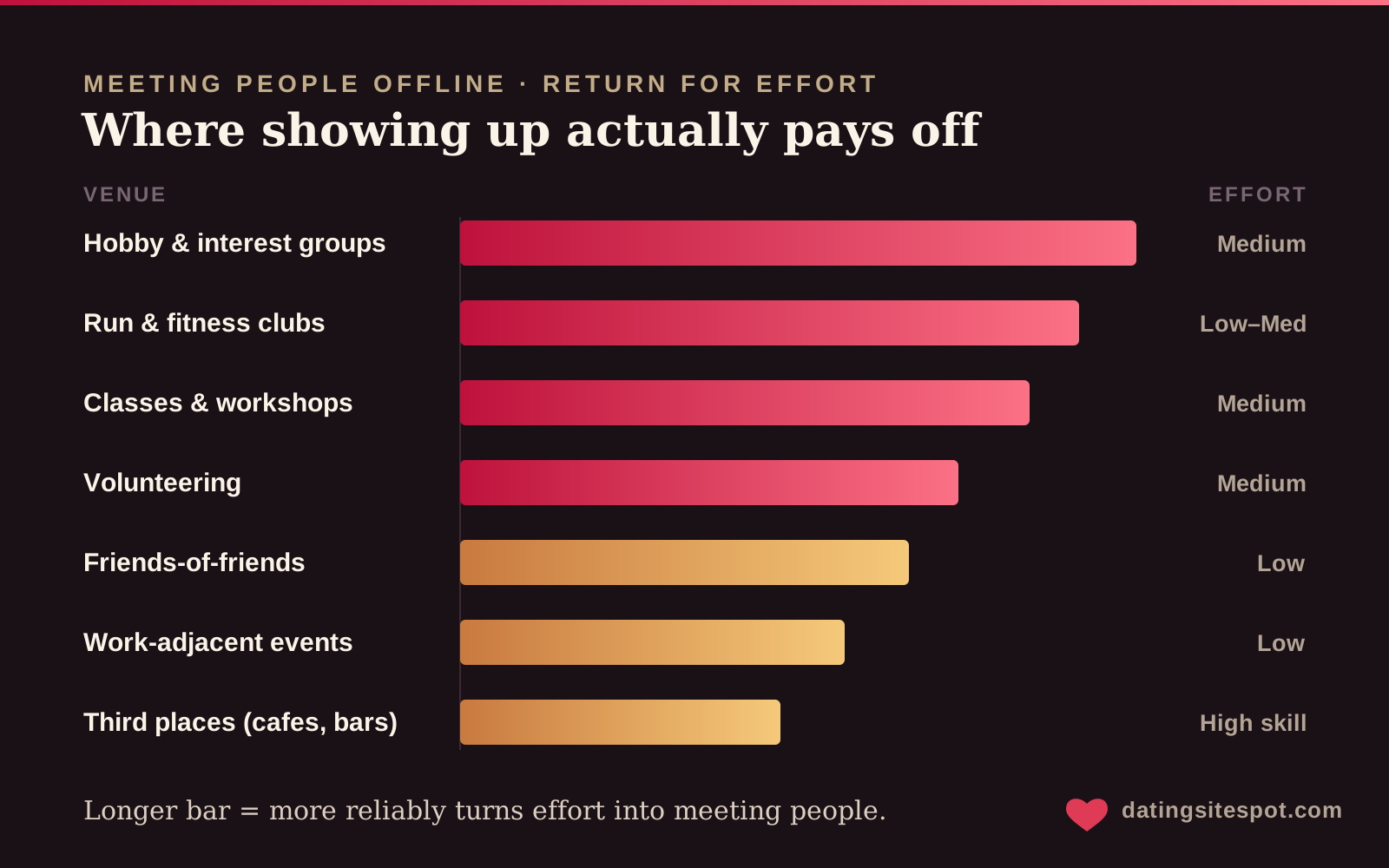 Ranked by return for realistic effort: the venues that hand you a built-in reason to talk pay off most; 'third places' work but ask the most of you.
1. Recurring hobby and interest groups — the highest return
This is the single best category, full stop. A board-game night, a climbing gym, a language exchange, a choir, a D&D table — anything with a fixed roster that meets weekly. Pick one thing you'd genuinely enjoy even if you met no one, and commit to eight weeks. The on-ramp is automatic: you already have the activity to talk about, and by week three you're a regular, not a stranger. Familiarity is the ingredient apps can't synthesize, and this is where you get it cheapest.
2. Run clubs and fitness communities — the momentum play
Run clubs have become one of the most talked-about real-world social scenes of the last two years, and the reason is structural: they meet on a fixed schedule, they end at a bar or a coffee shop, and shared exertion drops people's guard fast. [4] Show up to the same weekly run or class, hang around for the social part afterward — that's where the meeting actually happens, not mid-workout. Bootcamps, climbing gyms, and rec sports leagues work the same way. Low awkwardness, high repetition, and you get in shape as a consolation prize.
3. Classes and workshops — built-in pairing
A pottery class, an improv course, a cooking workshop, a dance series — anything that runs for several weeks and occasionally makes you partner up. Choose a multi-session course, not a one-off, so you see the same people again. The structure does the social lifting: shared beginner-level fumbling is a great equalizer, and "how did yours turn out?" is a conversation that writes itself. Improv and dance skew especially social because they force low-stakes interaction from minute one.
4. Volunteering — the values filter
Habitat builds, food banks, trail crews, animal shelters, festival stewarding. Sign up for a recurring shift rather than a single event, and you'll see the same crew regularly. The quiet advantage here is filtering: people who show up to help share a value set, which is more than you learn from any bio. It's lower-volume than a hobby group, but the people you meet are pre-screened for something that actually matters.
5. Friends-of-friends and hosted gatherings — highest trust, lowest volume
The oldest method still works: dinners, house parties, birthdays, a friend's "you two should meet." Say yes to more invitations than you want to, and — the part people skip — actually host things yourself. Volume is low, but trust is sky-high: a mutual friend is a reference check money can't buy. Tell a few close people you're open to introductions; most won't think to offer unless you ask out loud.
6. Work-adjacent events, meetups, and conferences — proceed with judgment
Industry meetups, conferences, coworking events, alumni mixers, and professional Meetup groups put you in a room of people with a shared context and an easy opener. Favor the after-hours social track over the formal sessions, where talking to strangers is the whole point. Keep the obvious boundary in mind — your direct workplace is a minefield, and a professional event is not a singles bar — but the wider orbit of your field is fair game and full of people you'd never match with online.
7. Third places — cafes, bars, bookstores, gyms
Sociologist Ray Oldenburg's "third place" is the neutral ground that isn't home or work — the cafe, the bar, the neighborhood bookshop, the regular gym. [5] Become a regular somewhere and let the staff and other regulars get to know you; connection comes from recognition over time, not a cold approach on day one. This category works, but it's ranked last for a reason: there's no shared activity handing you an opening, so it leans hardest on the social skills the apps let go soft — which brings us to the next part.
The skills the apps quietly let atrophy
Here's what a decade of swiping did that nobody warns you about: it moved the entire first act of dating — noticing someone, opening, reading interest, surviving a no — behind a screen, and those muscles get weak when you don't use them. The good news is they come back fast. Three worth rebuilding on purpose:
Approaching in context. You do not need pickup lines. In a shared activity, the opener is just the activity — "how long have you been coming to this?" is a complete and perfectly good approach. The skill isn't charm; it's saying the ordinary thing out loud instead of rehearsing it. Start with low-stakes reps — chat with the barista, the person next to you in class — so that by the time it matters, talking to a stranger is normal, not an event.
Carrying a conversation past the opener. Apps train you to volley pre-written lines; real conversation is asking a follow-up question and actually listening to the answer. The whole trick is curiosity over performance — you're finding out if you like them, not auditioning. Ask, listen, share a bit back, repeat. That's the entire technique.
Rejection tolerance. This is the big one, and the app format hid it — a non-reply feels anonymous and abstract. In person, a polite "it was nice to meet you" lands harder, so you have to reframe it: a no is information, not a verdict, and the person who hears more of them is usually the one who's actually out there trying. Treat every low-stakes interaction that goes nowhere as a rep, not a failure. Tolerance is trainable, and it's the muscle that makes every venue above actually work.
When apps still make sense (the honest section)
We review dating apps for a living, so we're not going to pretend they're useless. There are real situations where an app is the right tool, not a crutch:
- Thin or scattered local scenes. Small town, rural area, or a demographic that's rare where you live — apps widen the pool in a way no run club can.
- A genuinely tight schedule. If your life doesn't have room for a weekly commitment right now, an app meets you where you are.
- A specific search. Looking within a particular community, faith, ethnicity, or orientation is exactly where the right app earns its keep, because it lets you filter for something that's hard to find by chance.
- Rebuilding after a move. New city, no network yet? An app is a reasonable bridge while your offline life catches up.
If that's you, the answer isn't "download all of them and grind." It's pick one, use it with intent, and get to a real-world meeting fast — which is the whole argument of our ranked guide to which apps are actually worth it and our longer breakdown of the best dating apps by goal. And if what you're really weighing is companionship versus connection — a growing question in 2026 — we covered the tradeoffs in AI girlfriends vs. dating apps.
The point isn't apps-bad, offline-good. It's that the best results almost always come from one app used intentionally plus an offline life you'd want even if you were single forever — not from treating either one as the whole strategy. If you do keep an app, at least go in knowing what a year of it really costs, so it stays a tool and not a habit.
Frequently Asked Questions
How do I meet someone without dating apps?
Where can I meet singles in real life?
Is it weird to approach someone in person in 2026?
Is it harder to meet people without dating apps?
Sources
Sources
Every numbered claim in this review links back to a source below.
- DatingSiteSpot — The True Cost of Dating Apps in 2026 (our data study: 310 hours/year, cost breakdown)· accessed Jul 6, 2026
- BankMyCell & AppsFlyer — dating-app ghosting and engagement benchmarks (~74% ghosted; 84% among Gen Z/Millennials)· accessed Jul 6, 2026
- Business of Apps & AppsFlyer — app retention and uninstall benchmarks (>60% uninstall; <5% subscriber retention at one year)· accessed Jul 6, 2026
- Strava — community and run-club participation trends (2024–2025 Year in Sport)· accessed Jul 6, 2026
- Ray Oldenburg — 'The Great Good Place' and the concept of the third place· accessed Jul 6, 2026
Time-cost and dollar figures are drawn from our own True Cost of Dating Apps study; the venue ranking reflects our editorial assessment of realistic effort and return, not a survey. Last updated: July 6, 2026.