
Dating • Safety
Romance Scams in 2026: The $1.14 Billion Problem
Americans reported $1.14 billion in romance-scam losses to the FTC in 2023 — the most recent romance-specific federal total — and the FBI logged another $929 million in 2025. Both figures undercount the real damage, because the crypto 'pig-butchering' cons that now do the most harm are filed as investment fraud, not romance. The one-line defense hasn't changed: no one you've only met online should ever get your money, your crypto, or your gift-card numbers — and anyone who asks is running a script.
TL;DR — Key takeaways
- The scale: $1.14B reported to the FTC in 2023 (its latest romance-specific total) and $929M to the FBI in 2025. Both undercount the truth — the crypto 'pig-butchering' cons that cause the biggest losses now get counted as investment fraud.
- The tooling changed. Scammers now build fake profiles with AI-generated photos and run the conversation off AI chat scripts. The FBI tied over $19M in 2025 romance losses to a 'likely AI-nexus' — and calls that a floor, because victims usually can't tell.
- Crypto is the accelerant. When the payment is cryptocurrency the median loss is about $10,079, and crypto plus bank wires account for more than 60% of romance-scam dollars — the payment types that are hardest to claw back.
- It isn't just lonely retirees. In 2025 adults under 60 filed MORE romance-scam complaints than the 60-and-older group (11,535 vs 10,188). Seniors lose far more money per person, but younger adults report in high volume.
- If you've already paid, speed decides everything. The FBI's rapid-freeze process recovered $679M in 2025 — but only on bank wires caught fast, not crypto. Report at reportfraud.ftc.gov and ic3.gov immediately.
Romance scams are the rare category of fraud where the losses are enormous, the mechanics are well documented, and the defense is genuinely simple — and yet the numbers keep climbing. This is not a story that needs a tragic anecdote to land. The federal data does the work. Here is the actual record: how big the problem is, how the con is run in 2026, the specific signs that give it away, and exactly what to do if you're already in one.
The scale, and the number behind the number
Start with the headline, because it comes with an asterisk worth understanding. In 2023 — the most recent year for which the Federal Trade Commission has published a romance-specific total — Americans reported $1.14 billion in romance-scam losses across 64,003 reports, with a median loss of $2,000, the highest of any imposter-scam type[1]. That $1.14 billion is the number you'll see quoted everywhere, and it's real. It is also already dated, and the FTC has not since published a clean romance-only dollar figure — in its more recent data it folds romance into the broader "imposter scams" bucket.
The FBI counts differently, and more recently. Its Internet Crime Complaint Center (IC3) logged $929 million in "confidence fraud/romance" losses across 23,159 complaints in 2025[4]. Two agencies, two methods, two numbers — and neither tells the whole story. The reason is a reclassification that matters more than it sounds: the crypto-investment cons that begin as romance (the "pig butchering" schemes below) are now counted by the FBI as investment fraud, not romance. So both the FTC's $1.14 billion and the FBI's $929 million understate the money being stolen through relationships. The honest headline isn't one figure. It's that romance-initiated fraud is a billion-dollar-plus problem whose worst edge is now hidden inside a different column.
How the scam actually works in 2026
Strip away the specifics and every romance scam runs the same three-stage play.
Stage one — the approach. Contrary to the stereotype of the dating app, most romance scams now start on social media. In its 2025 data the FTC found that nearly 60% of reported romance scams began on a social platform — a direct message, a "wrong number" text, a friend request — not on a dating service[3]. The scammer's profile is engineered to be appealing and hard to verify.
Stage two — the isolation. Within days, the conversation moves off the platform where it started — to WhatsApp, Telegram, or plain text — and the relationship accelerates far faster than a real one would. The FTC lists the reasons the person can never meet or video-chat as a signature tell: they're deployed on a faraway military base or working on an offshore oil rig[1]. The point of this stage is to get you emotionally invested and away from anyone who might say the obvious thing out loud.
Stage three — the money story. Only then does the ask arrive, and it always has a narrative: a medical emergency, a stuck inheritance, a customs fee on a valuable package, or — increasingly — a generous offer to teach you how to make money in cryptocurrency. The FTC's rule cuts through all of it: "Nobody legit will ever ask you to help — or insist that you invest — by sending cryptocurrency, giving the numbers on a gift card, or by wiring money. Anyone who does is a scammer."[1]
The new tooling: AI photos and scripted affection
What's genuinely new in 2026 is the automation. The FBI's 2025 report devotes a section to AI in fraud and is blunt about the romance angle: "Scammers are creating fake profiles and scripts produced by AI chat generators to make speech more believable." It attributes more than $19 million in 2025 romance losses to a "likely AI-nexus" — and stresses that this is a floor, not a ceiling, because "many victims do not realize the extent AI may be involved."[4] Generative tools let one operator spin up convincing synthetic photos and run dozens of "relationships" from the same script at once. If you've wondered how a stranger's profile can look flawless and never appear on live video, this is the answer — and it's the same synthetic-persona problem we covered in are AI girlfriends safe, pointed at your wallet instead of your loneliness.
The crypto shift, and "pig butchering"
Follow the money and it increasingly ends in cryptocurrency. The FTC found that when the payment method is crypto, the median loss is about $10,079 — and that crypto and bank wires together account for more than 60% of all romance-scam dollars[2]. These are precisely the payment rails that are hardest to reverse, which is exactly why scammers steer you toward them.
The purest form of this is the con nicknamed "pig butchering": the scammer builds the relationship first, then introduces a "can't-lose" cryptocurrency investment, often on a fake trading platform that shows fabricated gains until you try to withdraw. The scale of the response tells you how serious it is. Under Operation Level Up, the FBI and Secret Service identified and notified 4,323 victims of crypto-investment fraud — and found that 76% of them did not yet know they were being scammed, saving an estimated $285.6 million in the process[5]. That "didn't know" figure is the whole game: by the time the money moves, the victim is defending the scammer, not doubting them.
The red flags — a checklist you can actually use
None of these prove a scam on their own. Stacked together, they're the pattern federal investigators describe. The bright-line ones — anything involving money — are enough by themselves.
- They can never meet in person or on live video. There's always a reason: overseas deployment, an oil rig, a hospital. Real people can eventually get on a video call; scammers stall[1].
- They move you off-platform fast. A quick push to WhatsApp, Telegram, or text — away from where the relationship started and where it could be reported[1].
- It gets serious unusually quickly. Declarations of love within days, before you've ever met, are a manipulation tactic, not a whirlwind.
- They ask for money, gift-card numbers, or a wire. This is the line. Per the FTC, anyone you met online who asks you to pay this way is a scammer — full stop[1].
- They offer to help you "invest," especially in crypto. The favor is the trap; the money goes straight to their wallet[1].
- A valuable package is "stuck" and needs a fee. A customs charge or delivery fee on a gift you never expected is a classic pretext[1].
If several of those sound familiar, run your own situation through the check below. It's built from this exact list, it stores nothing, and it points you to the right next step.
Interactive · private
Romance Scam Risk Check
Answer honestly. This is a private gut-check built from the exact red flags the FTC and FBI publish — not a diagnosis. The more that sound familiar, the more it’s worth stopping to look closer.
How it started, how it feels
The ask— any one of these is the line
This check runs entirely in your browser. Nothing you tap is saved, sent, or shared — there’s no server, no storage, and no tracking behind it.
Prefer a page of its own? The standalone Romance Scam Checker runs the same nine questions on a dedicated page, with the red-flag mapping and reporting steps laid out alongside it.
What to do if you're mid-scam — or already paid
If you recognize the pattern, the move is the same whether you've sent money or not: stop. Stop paying, stop contact, and don't send "just this once" to get earlier money back — that's how the second loss happens. Then act on two fronts.
Report it. File with the FTC at reportfraud.ftc.gov and the FBI at ic3.gov. These aren't just for the record: IC3 complaints feed the rapid-response process below, and the FBI's guidance is explicit that time is of the essence.
If you've already sent money, speed decides whether you get it back. Contact your bank or the payment provider immediately and ask them to recall the transfer. The FBI's Recovery Asset Team runs a "Financial Fraud Kill Chain" that froze $679 million across 3,900 incidents in 2025, a 58% success rate[4]. But read the fine print carefully: that mechanism works on bank wires and ACH transfers caught quickly — not on cryptocurrency. Once crypto leaves your wallet it is, for practical purposes, gone. That asymmetry is the single best argument for treating any crypto ask as the end of the conversation.
Who actually gets hit
The stereotype is a lonely retiree. The data tells a more uncomfortable story — and it's the part worth sitting with.
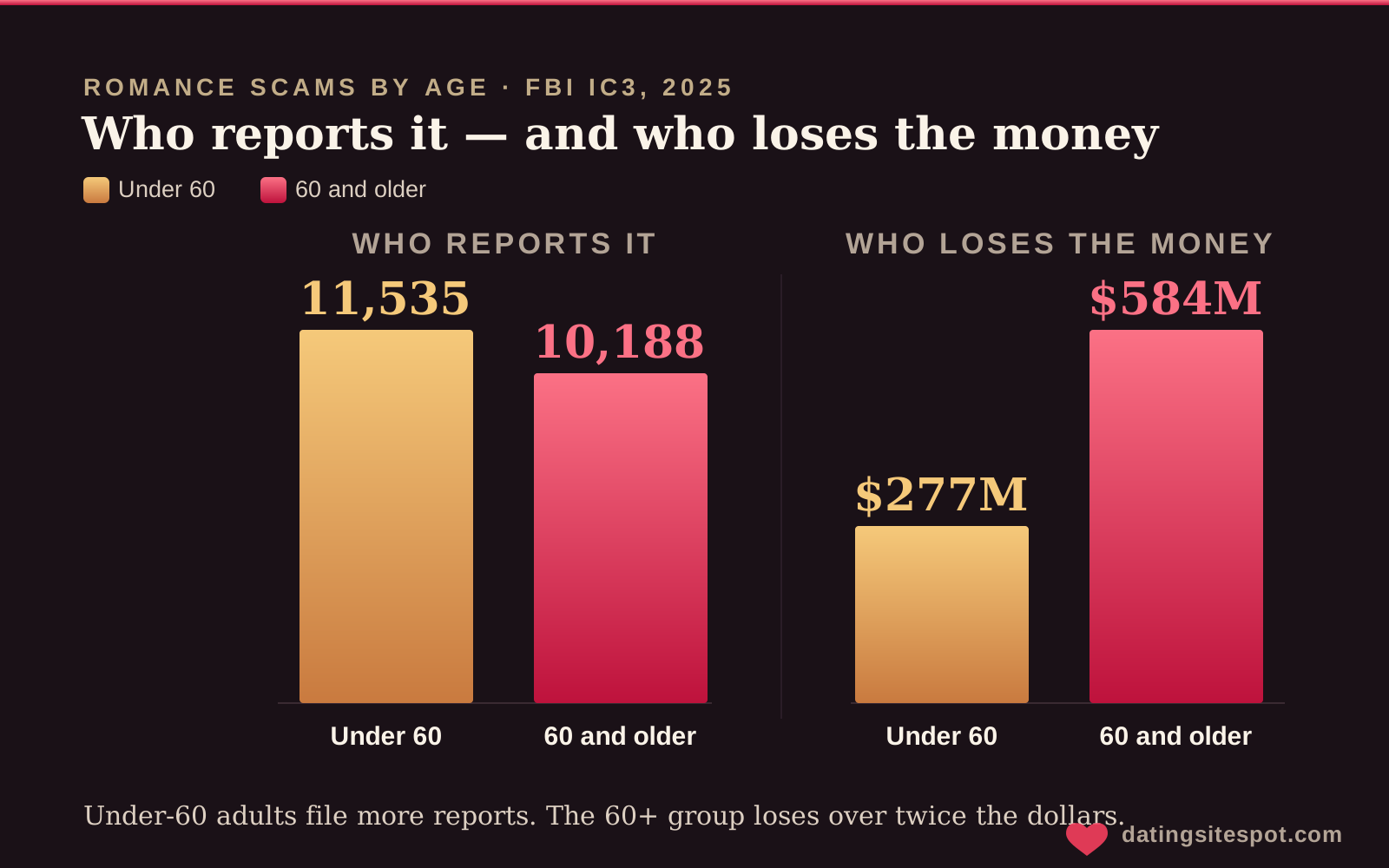 Under-60 adults file more romance-scam reports; the 60-and-older group loses more than twice the dollars (FBI IC3, 2025).
In 2025, adults under 60 filed more romance-scam complaints than the 60-and-older group — 11,535 versus 10,188[4]. Younger and middle-aged people are targeted in high volume, and they report it. Where the age gap yawns open is in the dollars: the 60-and-older group lost $584 million, more than twice the roughly $277 million lost by everyone under 60 combined[4]. So both halves of the cliché are wrong. It isn't only older people who get scammed — but when older people do, the losses are devastating. Anyone who assumes "this couldn't happen to me because I'm not the type" has the demographics exactly backwards.
How legit platforms verify — and where scams thrive
The 60%-start-on-social-media figure is not an accident. Established dating apps have identity checks, in-app reporting, and moderation teams with a commercial reason to remove scammers; a random direct message on a social platform has none of that friction. That doesn't make dating apps scam-free — no platform is — but it does mean the safest posture is to keep a new connection on the app until you've met, where a report actually goes somewhere. If you're choosing where to spend your time, our ranked guides to the best dating apps and our editorial best dating apps breakdown weigh exactly this kind of safety and verification alongside everything else.
The throughline of every section above is the same: the technology got better, the scripts got cheaper, and the losses got bigger — but the defense didn't move. Keep it on-platform, keep money out of it, and say it out loud to someone you trust the moment something feels off. That instinct is usually right.
Sources
Every numbered claim in this review links back to a source below.
- Federal Trade Commission — 'Love stinks — when a scammer is involved' (Feb 2024, 2023 data): $1.14B in romance-scam losses across 64,003 reports, $2,000 median; the military/oil-rig and crypto-'favor' tells and the bright-line payment rule· accessed Jul 6, 2026
- Federal Trade Commission — 'Romance scammers' favorite lies exposed' data spotlight (Feb 2023, 2022 data): ~$10,079 median loss when paid in crypto; crypto and bank wires >60% of romance-scam dollars; contact-method breakdown· accessed Jul 6, 2026
- FBI Internet Crime Complaint Center — 2025 Annual Report: $929M confidence/romance losses across 23,159 complaints; $584M lost by the 60+ group; the by-age complaint breakdown; >$19M in romance losses with a likely AI-nexus (and the AI 'fake profiles and scripts' quote); Financial Fraud Kill Chain froze $679M at a 58% success rate· accessed Jul 6, 2026
- FBI Internet Crime Complaint Center — 2024 Annual Report: Operation Level Up notified 4,323 crypto-investment-fraud victims, 76% of whom were unaware they were being scammed, saving an estimated $285.6M· accessed Jul 6, 2026