How we tested Grindr
We score Grindr across experience, value, audience and safety, then compare it against the category where it actually competes.
- Free-tier checked
- Audience fit reviewed
- Ranking cross-checked
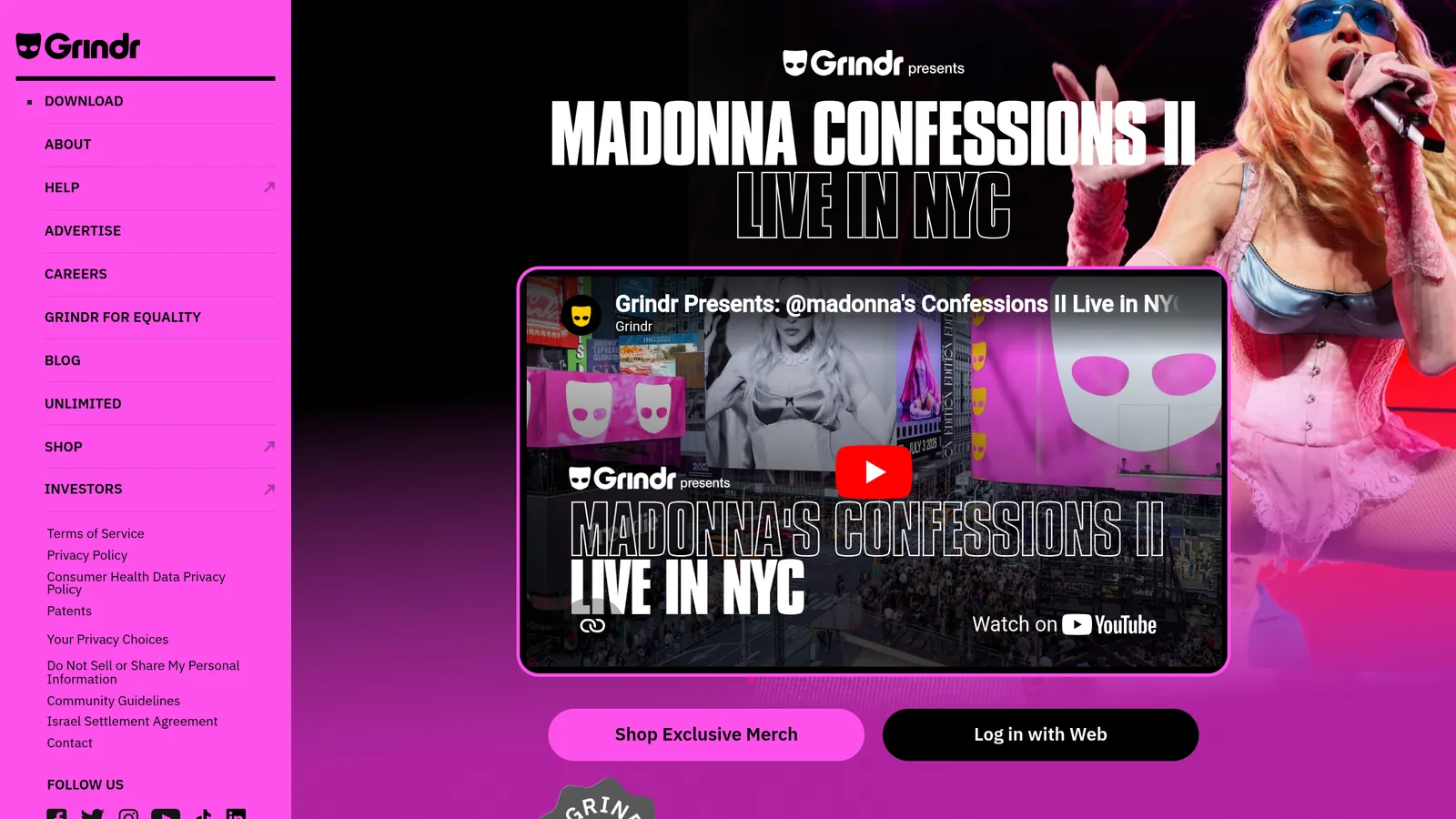
Screenshot
What Grindr actually looks like.
For gay, bi, trans and queer men in most major cities, Grindr isn't really a choice — it's the default, the app everyone's already on, with a density inside the niche that no LGBTQ-focused rival comes close to. It's also the app where we scored safety the lowest of any LGBTQ product here, for reasons that are a matter of public record rather than opinion. Both of those are true, and an honest review has to hold them together.
Who it's for
Grindr fits gay, bi, trans and queer men who want a location-first dating and social app with broad daily reach inside the niche, and who are comfortable with a culture that leans casual by default. If you're after a relationship-minded LGBTQ pool with stronger up-front filtering, treat Grindr as the baseline you compare against rather than the place you stop. And if privacy-by-design is a priority for you, its track record is a genuine factor to weigh.
What it does well
Reach inside the niche is the real strength. In every market we tested, Grindr's grid filled with active accounts at a density no LGBTQ-targeted alternative matched — for raw discovery within the audience, nothing else here is close. The location-first grid is the right primitive, too: instead of a swipe queue it shows who's online and nearby, which is how the audience actually uses the app. Onboarding is short, the basic flow works from the first session, and the apps are the cleanest LGBTQ-native dating surfaces among the mainstream products. The free tier also carries real two-way messaging — match-and-message isn't gated behind a subscription — so you can read the audience before deciding on XTRA or Unlimited, even though ads and visibility limits meter the experience in place of a paywall.
Where it costs you
Safety and privacy are the floor, and we won't paper over them. The public record includes repeated, well-documented incidents around location-data sharing, HIV-status handling and ad-tech privacy. Grindr has shipped fixes and communicated changes over the years, and today's product is materially better than its lowest points — but that history is exactly why the safety axis lands lowest of our LGBTQ coverage, and anyone who weights privacy heavily should account for it. The culture also leans casual by default: relationship-minded users will find the feed and the inbound-message pattern less aligned than on a curated alternative — a question of fit rather than a defect. And the free tier is metered by ads and visibility throttles, with XTRA and Unlimited prompts surfacing often enough to turn daily use into a preview; it doesn't shut the core flow down, but it does push the pace.
What you'd pay for
Grindr XTRA and Grindr Unlimited are tiered by feature surface and term length, with one-off Boost-style purchases. The free tier is enough to judge the audience inside the ad density and visibility limits; we'd only pay if the cumulative friction is actively getting in your way.
The bottom line
Grindr belongs at the top of the LGBTQ dating-apps list as the default inside its niche, on reach and a location-first design that fits the audience. We left it out of the overall ranking — it's LGBTQ-by-design, and slotting it into a general-audience list would mislead straight readers. Inside the niche it's the right baseline; the safety floor is the right reason to weigh alternatives alongside it.
Strengths & weaknesses
The honest balance sheet.
What works
- The default LGBTQ dating and social app for gay, bi, trans and queer men in most major markets — daily reach inside the niche is unmatched
- Location-first grid is the right primitive for the audience and works without onboarding overhead — the basic flow is usable on day one
- Free tier supports real two-way messaging with no inbox paywall, so the audience can be evaluated before considering Unlimited or XTRA
What doesn't
- Location-first design and historical product choices have produced repeated, well-documented privacy and safety incidents that ranked the safety axis lowest in our LGBTQ coverage
- Culture skews casual and hookup-leaning by default — relationship-minded users will find the recommended-matches feed less aligned than on a curated alternative
- Heavy ad surface on the free tier and persistent upsell prompts toward XTRA and Unlimited turn the free experience into a metered preview over a daily-use horizon
Who should use it
Use Grindr if any of this is you.
- You want first-class identity fields, not a checkbox layer.
- You want low-friction matching with minimal onboarding.
Who should skip it
Skip Grindr if any of this is you.
- You're dating in the 50+ bracket and want age-matched pools.
- Faith alignment is a hard filter for you.
Pricing reality check
Editorial coverageNo affiliate payout is attached to this review.
We cover this brand editorially. There is no sponsored link, no commission, and no paid placement on this page.
- Free tier
- Yes
- Messaging access
- Free tier with paid upgrades
- Upgrade pressure
- Moderate
Editor’s alternatives
Three reviews to read before you commit to Grindr.
Picked from sites that share the same audience and category placements as Grindr. No paid placements.
OkCupid7.6/10
The strongest free-tier dating product on the market, especially for members who want compatibility signals beyond a photo.
Read reviewZoosk7.3/10
A mainstream casual-leaning freemium product worth listing for broad reach, but the paywalled inbox and heavy upsell surface keep it behind OkCupid and POF for casual intent.
Read reviewBumble7.2/10
A mainstream app-first product with the most honest free start in our coverage and a women-message-first dynamic that sharpens reply quality — at the cost of pace, upsells and a weak web experience.
Read review
Read on
How Grindr fits the rest of our coverage.
Pulled from the live content graph: editor-tested intents this product plausibly fits, and head-to-heads against brands we already rank.
FAQ
Frequently asked questions about Grindr.
Generated from this review’s scoring + your-actually-asked questions. No invented numbers.
- Is Grindr worth it?
- Our editor scored Grindr 6.4/10. The default LGBTQ dating and social app inside its niche, with a location-first grid that fits the audience — kept honest by a documented privacy track record and a casual-leaning culture that not everyone is looking for.
- Is Grindr free?
- Partially — there's a free tier, but key features (typically messaging) sit behind a paid plan.
- Who is Grindr best for?
- Grindr is best for LGBTQ+ daters and casual daters who want low-friction matching.
- What is the biggest downside of Grindr?
- By the numbers, Grindr scores lowest on safety and moderation (5.4/10) — that's the trade-off to weigh first. The strengths-and-weaknesses breakdown above lays out the specifics.
- What is the best alternative to Grindr?
- If Grindr doesn't fit, we'd start with OkCupid — see /sites/okcupid/.
Where this also appears
Grindr is ranked in one other list.
Same review, scored against different lists. Each link below is the editorial ranking for that audience or use case.
Reviewed by
DatingSiteSpot Editorial
Independent review team · DatingSiteSpot
The DatingSiteSpot editorial team has reviewed dating and adult platforms since 2014. Every verdict comes from first-hand testing on accounts we create and pay for ourselves — no press kits, no stock screenshots, no AI mockups, no sponsored placements.
Methods · Dating app testing · Editorial reviews · Consumer comparison
Editorial review protocol
Read methodology →UX
tested signup → first match
Value
free tier vs paid wall
Audience
pool quality + fit
Safety
privacy + abuse signals
Score
overall on 10
Reviewed against the active 23-site category — every site we cover is scored on the same five axes.
Author focus
- Usability
- Pricing transparency
- Audience fit
- Privacy signals
Method · Five-axis rubric application · Paid-flow testing · Onboarding friction analysis · Cancellation flow documentation
- Reviewed
- · refreshed when the review or pricing changes
- Corrections
- [email protected]
Editorial protocol
- Reviewed using the same 5-axis rubric as every ranking.
- Corrections reviewed manually — no auto-publish.
- Affiliate relationships do not change the score (editorial policy).
- Tested on a real account — see how we test.