How we tested Bumble
We score Bumble across experience, value, audience and safety, then compare it against the category where it actually competes.
- Free-tier checked
- Audience fit reviewed
- Ranking cross-checked
Screenshot
What Bumble actually looks like.
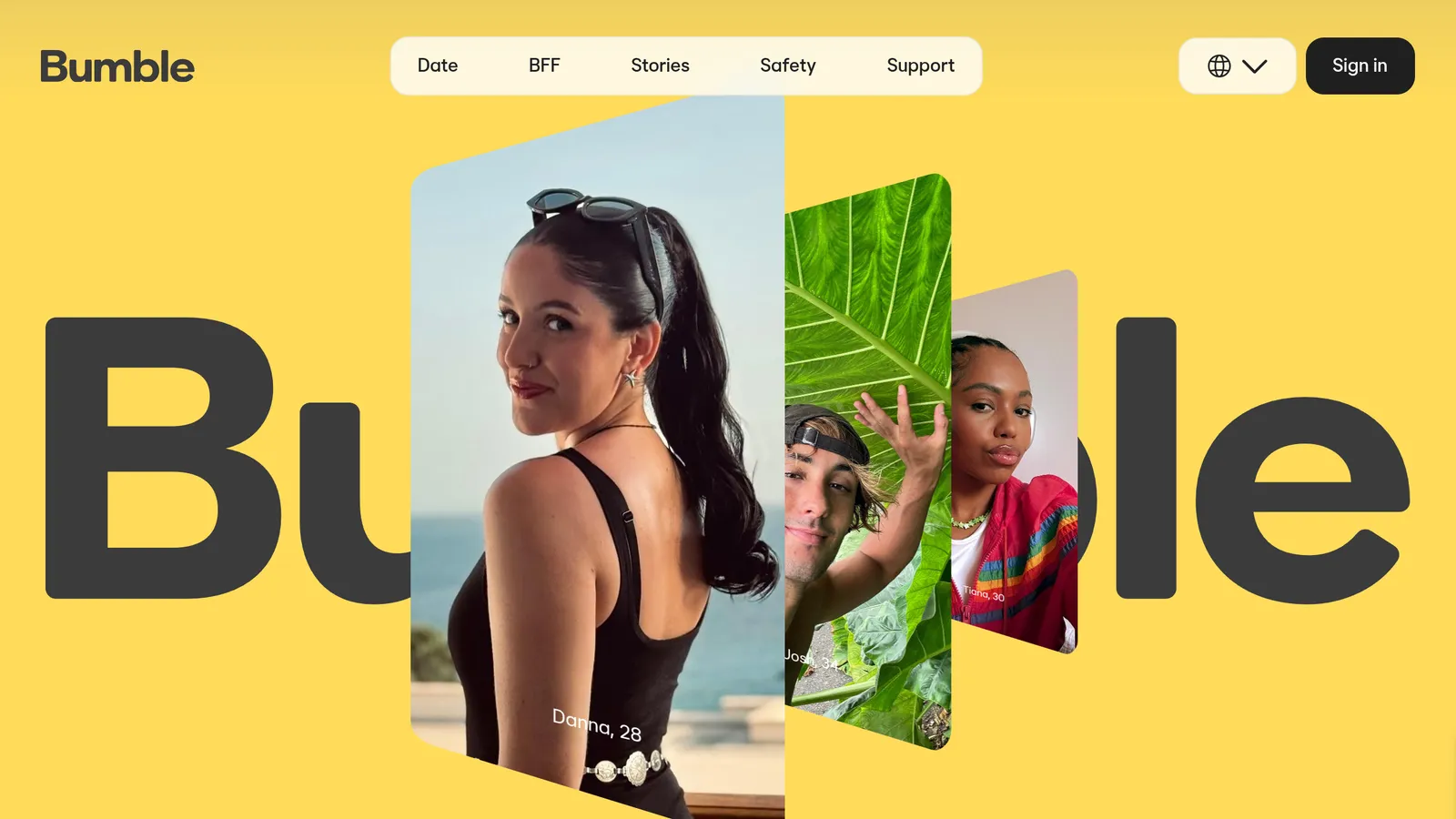
Bumble is the one mainstream swipe app we don't end up apologising for. The reason is narrow but it's real: women message first, and that first message doesn't sit behind a paywall. Most of the big apps make you pay just to say hello — Bumble doesn't, and that single decision quietly changes who bothers to show up in your inbox. It's a phone-first product through and through, and it pushes you to keep moving in a way the slower, website-led sites never do.
Who it's actually for
If your phone is where your dating life happens and you're somewhere between your late 20s and early 40s, Bumble is built for you. The flip side is just as clear. Do most of your swiping on a laptop at a relaxed pace? You'll be happier on OkCupid or Match, where the desktop experience is the real one. Want a small, vetted pool of people who are explicitly there to settle down? eHarmony does that job better. Bumble isn't trying to be either of those — it's a fast, app-native product, and it's honest about it.
The free tier that doesn't bait you
Here's where Bumble separates itself: it doesn't lock the inbox. Match with someone and you can send the first message — and keep the conversation going — without ever paying. That sounds small until you've used the rivals, where "free" usually means you can swipe all day but can't say a word until you subscribe. Because the free start is genuinely functional, Bumble lands on our free list on merit rather than as a technicality.
The on-ramp helps too. Sign-up is short, and the swipe-and-prompt flow is the tidiest of the mainstream apps. You get more to react to than a bare photo — prompts and lifestyle details give you an actual opener — and the moderation has the seasoned feel of a product that's been doing this a long time: reports and blocks behave the way they should.
Women message first — and your inbox feels it
This is the part that's structural rather than marketing. When women have to open, two things follow. Women get a shorter, self-selected queue instead of a flood. And men, on the occasions they get a window at all, tend to receive messages with some thought behind them, because the other person chose to start. Either way you see far fewer one-word "hey" openers than on a free-for-all app. The bill for all of this comes due as pace.
Where it wears thin
That pace is the 24-hour match window. Don't send a message in time and the match is gone. Daily users barely notice; anyone who treats dating as a weekly errand will find it nagging, and we couldn't switch it off without paying for a tier that removes the limit.
The web version is a courtesy, not a peer. It loads, it works, but it trails the iOS and Android apps on features and clearly isn't where the product lives. If your dating happens on a laptop, you'll feel boxed in next to OkCupid, Match or eHarmony.
And the upsells nudge a little too often. Spotlight, Premium and SuperSwipe prompts keep surfacing inside flows that are otherwise free — more than you'd hit on OkCupid — and over a few weeks of daily use the friction stacks up. None of it breaks anything, but the feel is closer to Zoosk than to a clean paid product.
What you'd pay for — and whether to bother
The paid side is Bumble Premium and Bumble Boost, priced by how long a term you commit to, plus one-off buys like Spotlight and SuperSwipes. You almost certainly don't need any of it to judge whether the audience is right and to get conversations going — the free tier covers that. The only reason to open your wallet is if the daily-use rhythm or the free-tier limits start actively getting in your way.
The bottom line
Bumble earns its place on our free, casual and overall lists: a free start that actually works, the cleanest app in the mainstream pack, and a women-first dynamic that genuinely reshapes inbox behaviour. It doesn't make the over-40 or serious-relationships lists — the audience skews younger and the pace works against a slower, commitment-minded search. Stacked against the website-led products we cover, it lands in the same neighbourhood as Zoosk: similar score, different set of trade-offs.
Strengths & weaknesses
The honest balance sheet.
What works
- The free tier is genuinely usable — matches and first messages happen without a paywall, which most mainstream apps cannot say
- App UX is the cleanest in the mainstream tier — onboarding is short and the swipe flow is faster than on a questionnaire-driven product
- Women-message-first dynamic reduces inbound noise for women and raises reply quality on the men side, when men get a window at all
What doesn't
- App-first by design — the web product is a fallback, not a peer of the iOS and Android apps, so desktop-led readers get a thinner experience
- The 24-hour match window forces pace and rewards heavy daily use rather than weekly check-ins
- Spotlight, Premium and SuperSwipe upsells appear inside otherwise free flows often enough to add friction over a daily-use horizon
Who should use it
Use Bumble if any of this is you.
- You want low-friction matching with minimal onboarding.
- You want long-term commitment, not a swipe queue.
Who should skip it
Skip Bumble if any of this is you.
- You're dating in the 50+ bracket and want age-matched pools.
- Faith alignment is a hard filter for you.
Pricing reality check
FreemiumUsable free tier, but upgrades may affect visibility or messaging.
You can sign up and use the product without paying, but features that nudge replies or surface profiles are usually behind a paid plan.
- Free tier
- Yes
- Messaging access
- Free tier with paid upgrades
- Upgrade pressure
- Moderate
Editor’s alternatives
Three reviews to read before you commit to Bumble.
Picked from sites that share the same audience and category placements as Bumble. No paid placements.
Tinder6.0/10
The biggest mainstream swipe pool by a wide margin — useful for casual discovery, weak on signal, and increasingly metered by paid tiers that turn the free experience into a preview.
Shares: best-casual-dating-sites, best-dating-apps
Read reviewOkCupid7.6/10
The strongest free-tier dating product on the market, especially for members who want compatibility signals beyond a photo.
Shares: best-casual-dating-sites, best-free-dating-sites
Read reviewHinge7.0/10
An app-first relationship-leaning product with the strongest profile-prompt mechanic in mainstream coverage — best for urban 20s and 30s, weakest outside dense markets and on desktop.
Shares: best-dating-apps, best-free-dating-sites
Read review
Read on
How Bumble fits the rest of our coverage.
Pulled from the live content graph: editor-tested intents this product plausibly fits, and head-to-heads against brands we already rank.
Best for
Casual dating
Lower-friction matching without commitment-first framing.
Hookups
Low-commitment, high-velocity matching. We surface the products designed for it without recommending sites we haven't tested.
Free-first dating
Apps with a genuinely usable free tier.
Introvert dating
Slower-paced, lower-volume products built around prompts, curated matches, and async messaging.
Compared with
FAQ
Frequently asked questions about Bumble.
Generated from this review’s scoring + your-actually-asked questions. No invented numbers.
- Is Bumble worth it?
- Our editor scored Bumble 7.2/10. A mainstream app-first product with the most honest free start in our coverage and a women-message-first dynamic that sharpens reply quality — at the cost of pace, upsells and a weak web experience.
- Is Bumble free?
- Partially — there's a free tier, but key features (typically messaging) sit behind a paid plan.
- Who is Bumble best for?
- Bumble is best for casual daters who want low-friction matching and people optimising for a long-term relationship.
- What is the biggest downside of Bumble?
- By the numbers, Bumble scores lowest on audience quality (7.0/10) — that's the trade-off to weigh first. The strengths-and-weaknesses breakdown above lays out the specifics.
- What is the best alternative to Bumble?
- If Bumble doesn't fit, we'd start with Tinder — see /sites/tinder/.
Where this also appears
Bumble is ranked in 4 other lists.
Same review, scored against different lists. Each link below is the editorial ranking for that audience or use case.
Reviewed by
DatingSiteSpot Editorial
Independent review team · DatingSiteSpot
The DatingSiteSpot editorial team has reviewed dating and adult platforms since 2014. Every verdict comes from first-hand testing on accounts we create and pay for ourselves — no press kits, no stock screenshots, no AI mockups, no sponsored placements.
Methods · Dating app testing · Editorial reviews · Consumer comparison
Editorial review protocol
Read methodology →UX
tested signup → first match
Value
free tier vs paid wall
Audience
pool quality + fit
Safety
privacy + abuse signals
Score
overall on 10
Reviewed against the active 23-site category — every site we cover is scored on the same five axes.
Author focus
- Usability
- Pricing transparency
- Audience fit
- Privacy signals
Method · Five-axis rubric application · Paid-flow testing · Onboarding friction analysis · Cancellation flow documentation
- Reviewed
- · refreshed when the review or pricing changes
- Corrections
- [email protected]
Editorial protocol
- Reviewed using the same 5-axis rubric as every ranking.
- Corrections reviewed manually — no auto-publish.
- Affiliate relationships do not change the score (editorial policy).
- Tested on a real account — see how we test.