How we tested Hinge
We score Hinge across experience, value, audience and safety, then compare it against the category where it actually competes.
- Free-tier checked
- Audience fit reviewed
- Ranking cross-checked
Screenshot
What Hinge actually looks like.
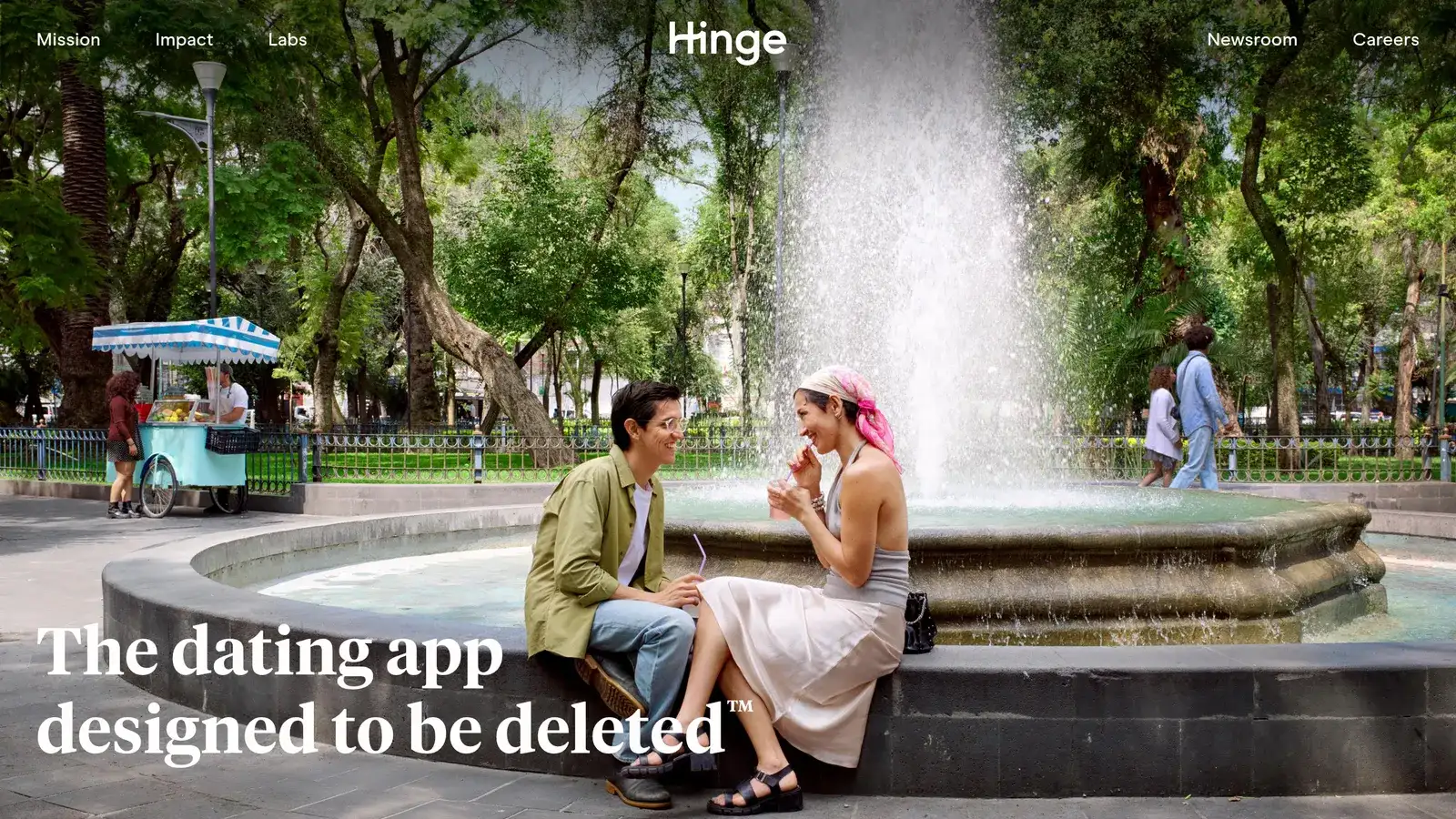
If Tinder is about how many people you can see, Hinge is about whether any of them will write back something worth reading. It's the mainstream swipe app that bet on prompts instead of photos, and the bet mostly paid off: you match with relationship intent more often here than on Tinder or Badoo — provided you're in a city big enough to keep the feed fed.
Who it suits
Hinge is built for people in their mid-20s to mid-30s in dense urban markets who already run their dating life from their phone and want something pitched at relationships without a long sign-up quiz. If you'd rather have a vetted, commitment-minded pool gated behind paid messaging, eHarmony is the cleaner choice. If you just want the widest casual net, Tinder is the bigger one.
What works
The prompts are the real differentiator. Instead of liking a face, you respond to a specific prompt answer, which forces a little commitment with every outbound and reliably produces better first messages than a bare swipe queue. It genuinely changes what the opening three messages look like.
The crowd leans the way the marketing promises. Hinge has built itself around the "designed to be deleted" line since its relaunch, and the daily feed reflects that intent more than a generic pool of the same size — at the same address, we saw fewer obviously casual profiles than on Tinder. And the free tier is real, just portioned: once you match, messaging isn't gated; the only limit is how many likes you can send per day.
Where it gets thin
Hinge lives entirely on its phone apps. There's no desktop product worth the name, so if you do most of your dating on a laptop, there's simply nothing here for you — which is the main reason it sits below the website-led products for older daters.
The daily likes cap also bites harder than Bumble's 24-hour clock: you can burn through it in a few minutes, and then it's wait or pay. It's not a dealbreaker, but quick swipers will feel the free tier turn into a teaser. Geography matters a lot, too — in big metros the pool is deep and relationship-leaning; outside them it thins fast, and the under-40 skew makes it a poor fit for the over-40 bracket even where it's available, which is why we left it off that list.
What you'd pay for
Hinge Premium and HingeX scale by term length, with one-off boost-style add-ons. The free tier is enough to read the audience inside a daily likes budget; paying only makes sense if the cap and the prompts start getting in your way.
The bottom line
Hinge belongs on the dating-apps, serious-relationships, free and overall shortlists — for a relationship-leaning crowd, a prompt system that lifts opener quality, and a free tier that's rationed rather than locked. It's not one for the over-40 list: the audience skews young, and the phone-only design shuts out the desktop-led daters who tend to fill that bracket.
Strengths & weaknesses
The honest balance sheet.
What works
- Prompt-driven profile gives readers something other than photos to react to, which lifts opener quality versus a pure swipe app
- Audience leans relationship-minded inside its 20s and 30s skew, with a marketing pitch ("designed to be deleted") that self-selects intent
- Like-a-prompt mechanic forces a small commitment per outbound and tends to surface fewer one-word openers than a standard swipe queue
What doesn't
- App-first by design — there is no peer-grade desktop product, so readers who do most of their dating on a laptop will find no real surface to use
- The free tier is metered by a small daily likes cap rather than by paywalled messaging, which means free use is real but rationed
- Outside dense urban markets the recommended-matches feed thins quickly, and the audience skew limits the over-40 fit
Who should use it
Use Hinge if any of this is you.
- You want long-term commitment, not a swipe queue.
- You want low-friction matching with minimal onboarding.
Who should skip it
Skip Hinge if any of this is you.
- You're dating in the 50+ bracket and want age-matched pools.
- Faith alignment is a hard filter for you.
Pricing reality check
Editorial coverageNo affiliate payout is attached to this review.
We cover this brand editorially. There is no sponsored link, no commission, and no paid placement on this page.
- Free tier
- Yes
- Messaging access
- Free tier with paid upgrades
- Upgrade pressure
- Moderate
Editor’s alternatives
Three reviews to read before you commit to Hinge.
Picked from sites that share the same audience and category placements as Hinge. No paid placements.
OkCupid7.6/10
The strongest free-tier dating product on the market, especially for members who want compatibility signals beyond a photo.
Shares: best-free-dating-sites, best-overall
Read reviewBumble7.2/10
A mainstream app-first product with the most honest free start in our coverage and a women-message-first dynamic that sharpens reply quality — at the cost of pace, upsells and a weak web experience.
Shares: best-dating-apps, best-free-dating-sites
Read reviewOurTime7.9/10
The most credible mainstream option for over-50 dating, specifically because the product respects its audience rather than condescending to it.
Shares: best-free-dating-sites, best-overall
Read review
Read on
How Hinge fits the rest of our coverage.
Pulled from the live content graph: editor-tested intents this product plausibly fits, and head-to-heads against brands we already rank.
Best for
Serious relationships
Daters optimising for a long-term partner; questionnaire-led, paid-first products.
Casual dating
Lower-friction matching without commitment-first framing.
Professional dating
Career-focused, time-poor daters — questionnaire-led, paid-first products.
Free-first dating
Apps with a genuinely usable free tier.
Compared with
FAQ
Frequently asked questions about Hinge.
Generated from this review’s scoring + your-actually-asked questions. No invented numbers.
- Is Hinge worth it?
- Our editor scored Hinge 7.0/10. An app-first relationship-leaning product with the strongest profile-prompt mechanic in mainstream coverage — best for urban 20s and 30s, weakest outside dense markets and on desktop.
- Is Hinge free?
- Partially — there's a free tier, but key features (typically messaging) sit behind a paid plan.
- Who is Hinge best for?
- Hinge is best for people optimising for a long-term relationship and casual daters who want low-friction matching.
- What is the biggest downside of Hinge?
- By the numbers, Hinge scores lowest on value for the money (6.4/10) — that's the trade-off to weigh first. The strengths-and-weaknesses breakdown above lays out the specifics.
- What is the best alternative to Hinge?
- If Hinge doesn't fit, we'd start with OkCupid — see /sites/okcupid/.
Where this also appears
Hinge is ranked in 4 other lists.
Same review, scored against different lists. Each link below is the editorial ranking for that audience or use case.
Reviewed by
DatingSiteSpot Editorial
Independent review team · DatingSiteSpot
The DatingSiteSpot editorial team has reviewed dating and adult platforms since 2014. Every verdict comes from first-hand testing on accounts we create and pay for ourselves — no press kits, no stock screenshots, no AI mockups, no sponsored placements.
Methods · Dating app testing · Editorial reviews · Consumer comparison
Editorial review protocol
Read methodology →UX
tested signup → first match
Value
free tier vs paid wall
Audience
pool quality + fit
Safety
privacy + abuse signals
Score
overall on 10
Reviewed against the active 23-site category — every site we cover is scored on the same five axes.
Author focus
- Usability
- Pricing transparency
- Audience fit
- Privacy signals
Method · Five-axis rubric application · Paid-flow testing · Onboarding friction analysis · Cancellation flow documentation
- Reviewed
- · refreshed when the review or pricing changes
- Corrections
- [email protected]
Editorial protocol
- Reviewed using the same 5-axis rubric as every ranking.
- Corrections reviewed manually — no auto-publish.
- Affiliate relationships do not change the score (editorial policy).
- Tested on a real account — see how we test.