How we tested Match
We score Match across experience, value, audience and safety, then compare it against the category where it actually competes.
- Paid-flow checked
- Audience fit reviewed
- Ranking cross-checked
Screenshot
What Match actually looks like.
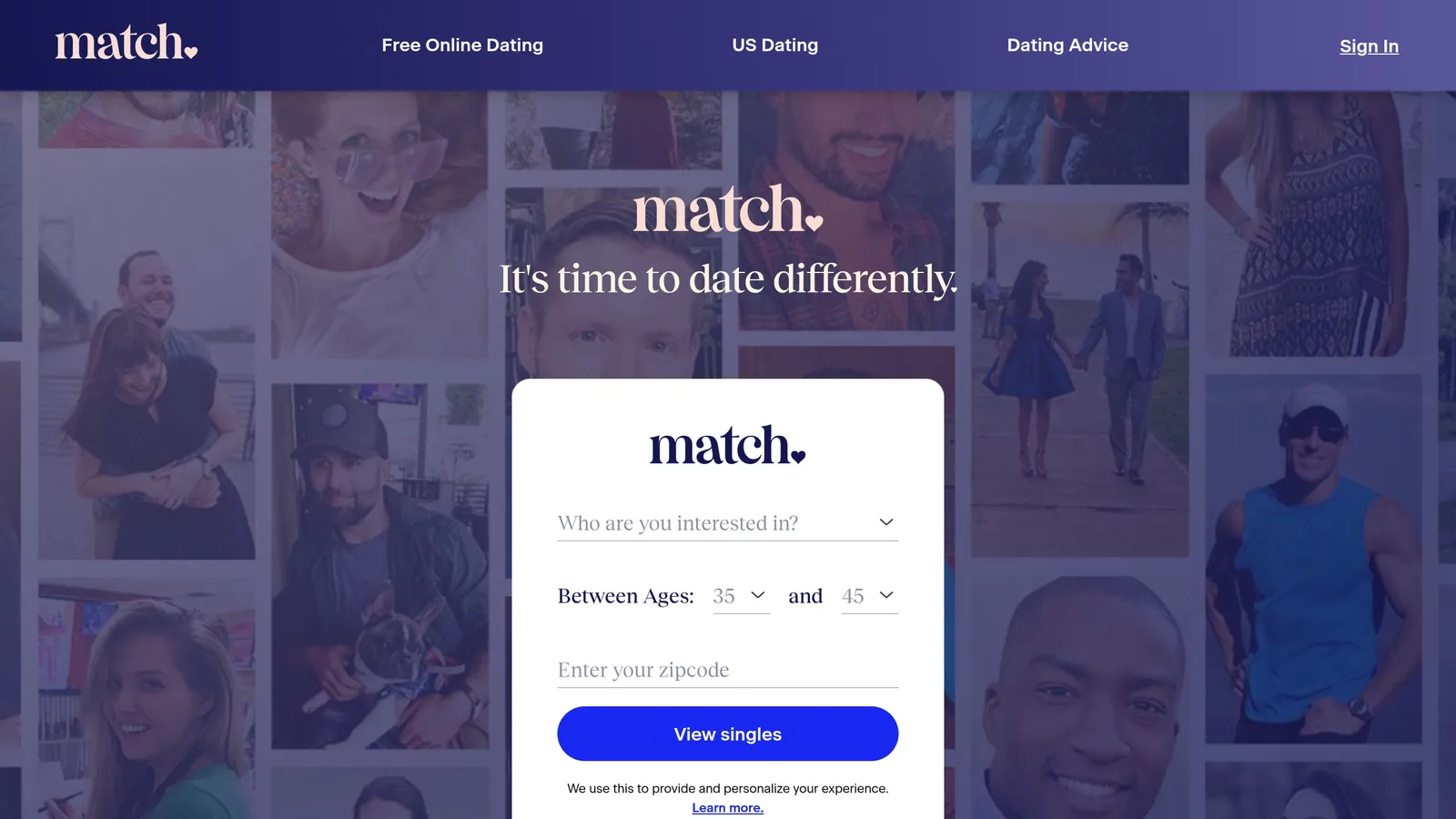
Match's pitch is simple and a little old-fashioned: pay, and get the broadest pool of people who are genuinely serious about dating. It's been around longer than most of what it competes with, and it's still the name people reach for when they picture "a dating site you pay for." What you're buying is reach — and the job of sorting through that reach yourself, which a tighter product like eHarmony does for you.
Who it's for
Match fits adults in their 30s, 40s and 50s who want a paid, intentional product but don't want to be boxed into a niche or sat down for a forty-minute questionnaire. If you'd rather scan a wide pool than fill out a long quiz, this is the closer fit. If you've already decided you want a vetted, commitment-minded shortlist handed to you, eHarmony is the cleaner pick.
What you're paying for
Breadth is the point. Match runs one of the larger serious-paid audiences around, and that scale is most obvious away from the big coastal metros, where curated subscription products start to run dry. The profiles are fuller than most freemium rivals, too — prompts, lifestyle details and longer bios are the norm rather than the exception, so there's something real to read before you reach out. And the unglamorous basics — verification, support, moderation, account recovery, photo checks — all work the way a product with this many years behind it should. That gap over newer apps is genuine.
Where it costs you
You'll do more vetting here than on a questionnaire-led site, and that's structural: Match doesn't screen intent up front. Its members run from "ready this year" to "just browsing," and both get the same surface — so the cost per good match runs higher than eHarmony did in our testing. The visibility-boost and "promote your profile" nudges also show up more than they ought to at this price. It won't ruin the experience, but the upsell layer sits heavier than on eHarmony or OurTime.
What it costs
Match sells a tiered subscription priced by term length, sitting in the normal mainstream range for paid serious-dating. The six-month plan is the sensible entry point; skip the one-month unless you're specifically sampling the audience in your own market before you commit.
The bottom line
If you want a paid, serious product without locking into a niche or a long quiz, Match is the mainstream anchor — wider than eHarmony, more deliberate than OkCupid or Plenty of Fish. It's the right call when you want reach plus the option to pay for better filtering, and the wrong one when what you really want is a small, vetted pool delivered to your door.
Strengths & weaknesses
The honest balance sheet.
What works
- Mainstream paid product with the broadest serious-dating pool we test
- Profile fields and prompts are deeper than freemium competitors
- Long operating history means verification, support and moderation are mature
What doesn't
- Paid messaging plus a wide audience means more filtering work than eHarmony
- Visibility-boost upsells appear more often than they should at this price
- Intent varies more widely than questionnaire-driven products — expect to vet harder
Who should use it
Use Match if any of this is you.
- You want long-term commitment, not a swipe queue.
Who should skip it
Skip Match if any of this is you.
- You're dating in the 50+ bracket and want age-matched pools.
- Faith alignment is a hard filter for you.
- You won't pay for a subscription before testing.
Pricing reality check
Subscription requiredExpect to pay before messaging.
The product is paid by design. Browsing is limited, and the core conversation surface sits behind a subscription.
- Free tier
- No
- Messaging access
- Paid plan required
- Upgrade pressure
- High — paid by design
Editor’s alternatives
Three reviews to read before you commit to Match.
Picked from sites that share the same audience and category placements as Match. No paid placements.
eHarmony8.0/10
The deepest serious-relationship questionnaire in the category — strongest pick if you want commitment intent and accept slow, paid onboarding; the wrong product if you want casual or free browsing.
Shares: best-dating-sites-over-40, best-overall
Read reviewOurTime7.9/10
The most credible mainstream option for over-50 dating, specifically because the product respects its audience rather than condescending to it.
Shares: best-dating-sites-over-40, best-overall
Read reviewOkCupid7.6/10
The strongest free-tier dating product on the market, especially for members who want compatibility signals beyond a photo.
Shares: best-dating-sites-over-40, best-overall
Read review
Read on
How Match fits the rest of our coverage.
Pulled from the live content graph: editor-tested intents this product plausibly fits, and head-to-heads against brands we already rank.
Best for
Serious relationships
Daters optimising for a long-term partner; questionnaire-led, paid-first products.
Over 50
Age-aligned pools and slower-paced UIs for daters 50 and older.
Professional dating
Career-focused, time-poor daters — questionnaire-led, paid-first products.
Introvert dating
Slower-paced, lower-volume products built around prompts, curated matches, and async messaging.
Compared with
FAQ
Frequently asked questions about Match.
Generated from this review’s scoring + your-actually-asked questions. No invented numbers.
- Is Match worth it?
- Our editor scored Match 7.6/10. A mainstream paid anchor for adults who want serious dating without a long questionnaire — broader than eHarmony, more intentional than the free options.
- Is Match free?
- No — it's a paid subscription product.
- Who is Match best for?
- Match is best for people optimising for a long-term relationship.
- What is the biggest downside of Match?
- By the numbers, Match scores lowest on value for the money (7.0/10) — that's the trade-off to weigh first. The strengths-and-weaknesses breakdown above lays out the specifics.
- What is the best alternative to Match?
- If Match doesn't fit, we'd start with eHarmony — see /sites/eharmony/.
Where this also appears
Match is ranked in 3 other lists.
Same review, scored against different lists. Each link below is the editorial ranking for that audience or use case.
Reviewed by
DatingSiteSpot Editorial
Independent review team · DatingSiteSpot
The DatingSiteSpot editorial team has reviewed dating and adult platforms since 2014. Every verdict comes from first-hand testing on accounts we create and pay for ourselves — no press kits, no stock screenshots, no AI mockups, no sponsored placements.
Methods · Dating app testing · Editorial reviews · Consumer comparison
Editorial review protocol
Read methodology →UX
tested signup → first match
Value
free tier vs paid wall
Audience
pool quality + fit
Safety
privacy + abuse signals
Score
overall on 10
Reviewed against the active 23-site category — every site we cover is scored on the same five axes.
Author focus
- Usability
- Pricing transparency
- Audience fit
- Privacy signals
Method · Five-axis rubric application · Paid-flow testing · Onboarding friction analysis · Cancellation flow documentation
- Reviewed
- · refreshed when the review or pricing changes
- Corrections
- [email protected]
Editorial protocol
- Reviewed using the same 5-axis rubric as every ranking.
- Corrections reviewed manually — no auto-publish.
- Affiliate relationships do not change the score (editorial policy).
- Tested on a real account — see how we test.